AGENTIX · CASE FILE / 03 CONSTRUCTION · VIEWPOINT VISTA ERP / 2026
§ Case file · production system

VistaGPT

Talk to your Vista ERP, and trust the number that comes back

Viewpoint Vista is a 20-year-old construction ERP only a DBA can safely query, and a generic LLM hallucinates its schema ~74% of the time, producing confidently-wrong reports 5–30% off with no error message. VistaGPT encodes two decades of Vista tribal knowledge into a verified knowledge engine and deterministic validators, then turns a plain-English question into validated SQL, an automated Excel workbook, or a published Power BI dashboard. Finance teams stop waiting on the DBA, and the consultants who get paid to build those reports, workflows and dashboards do it in a fraction of the time. It is engineered to refuse rather than guess.

0 verified Vista schema entries grounded
0/100 audited SQL eval · CrewGPT
0% hallucination cut · 74.5% → 20.5%
0 construction clients in production
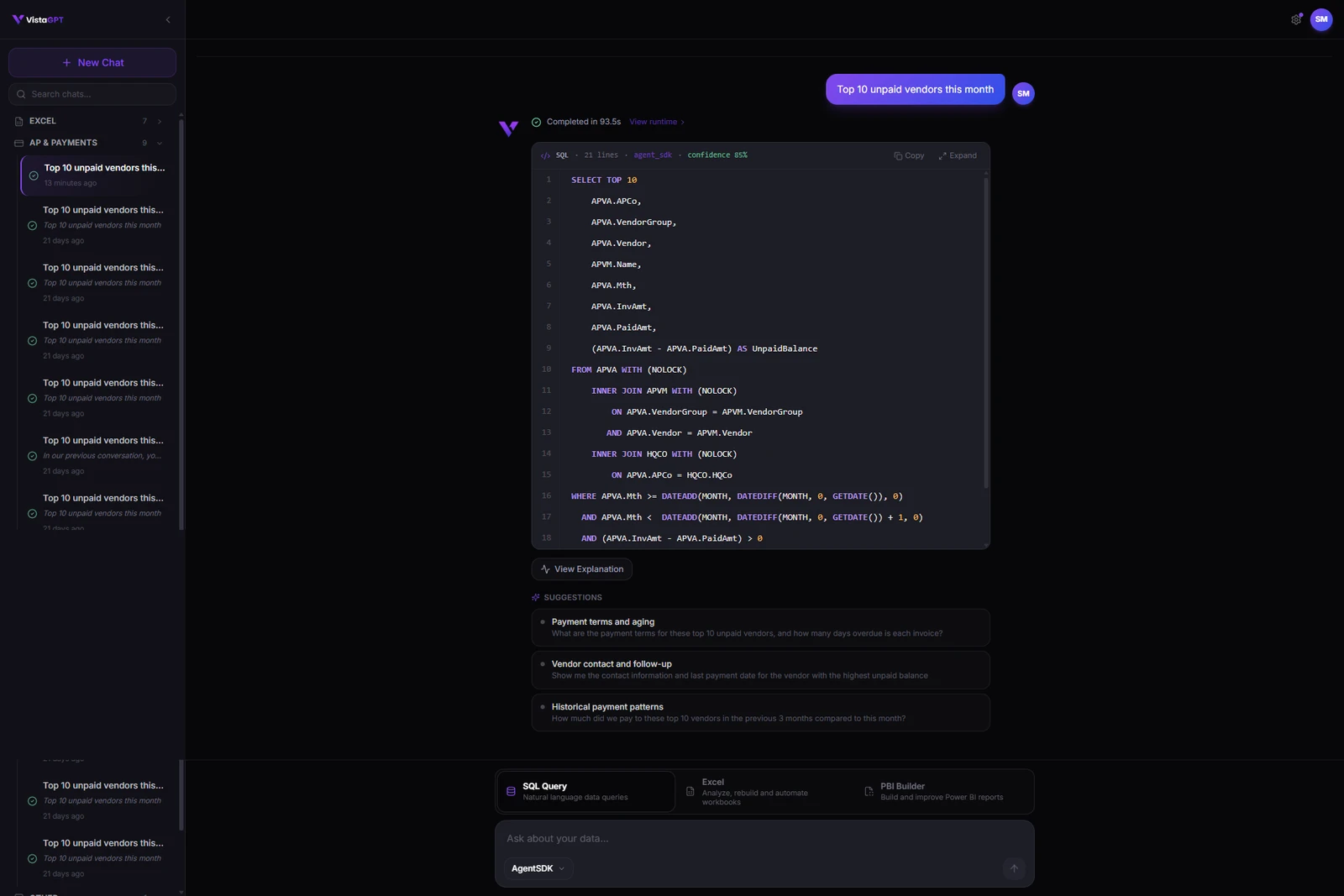
FIG.00, VistaGPT chat → validated T-SQL (representative output · illustrative reconstruction, not a live screenshot)
§ The product, live

The reconstruction
above, running live.

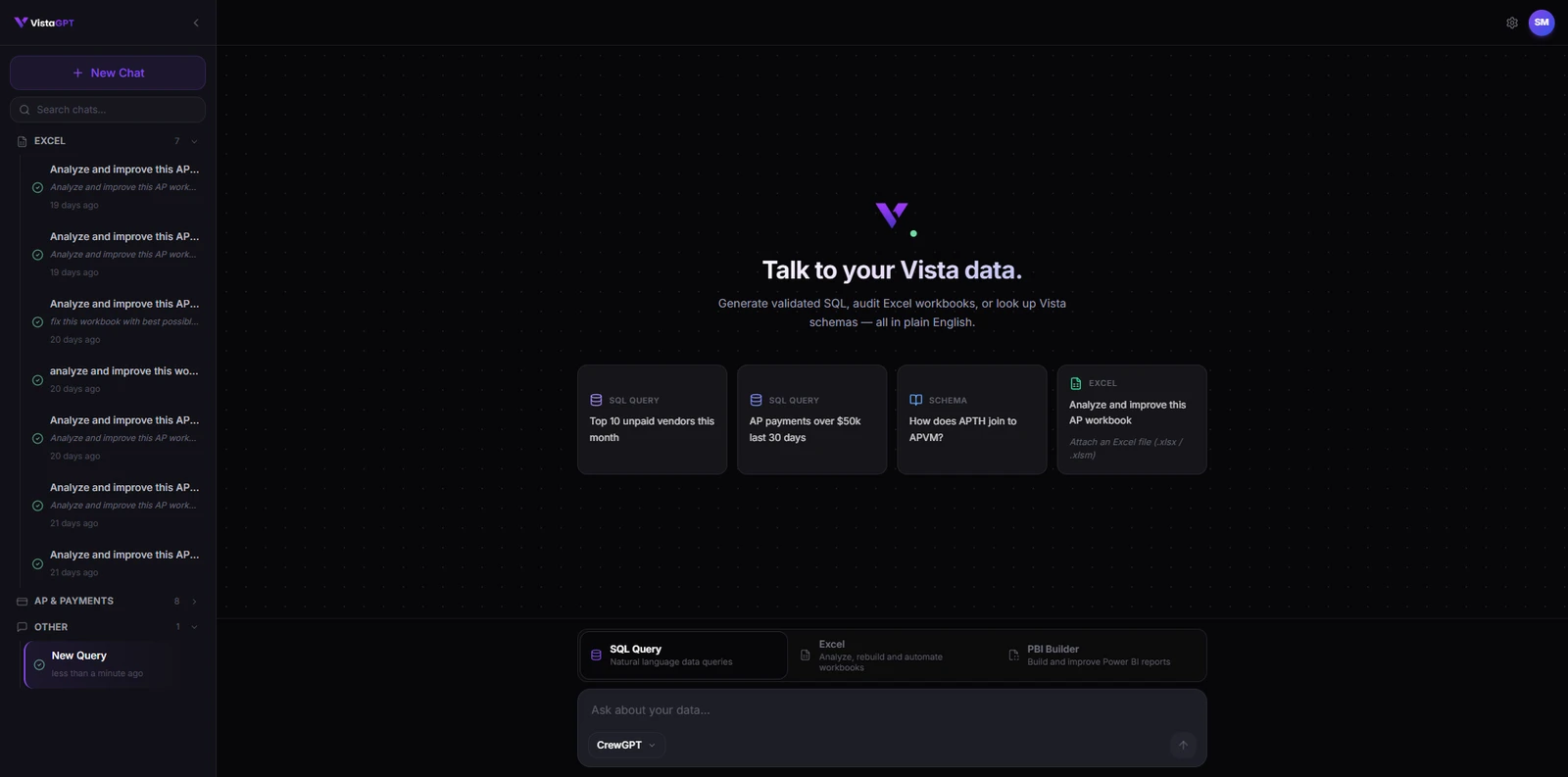
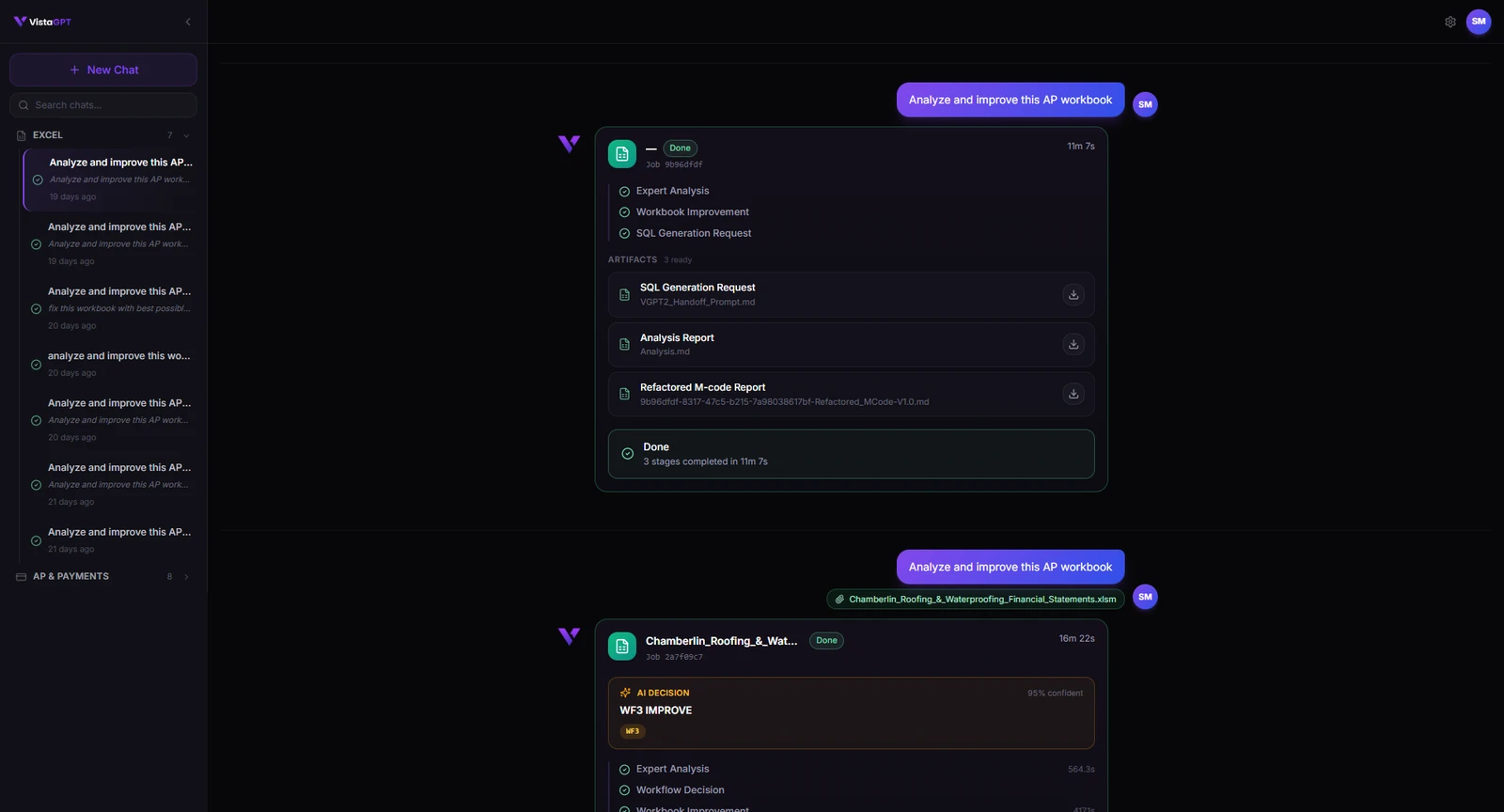
VistaGPT in production, replayed end to end: ask in plain English, watch the workflow run and check off, and read back validated T-SQL grounded in the real Vista schema.

VistaGPT · Ask: One chat over your ERP, spreadsheets and P&L — pick a specialist agent.
VistaGPT · Workflow: Each step validated and checked off — ending in a finished deliverable.
VistaGPT · Validated SQL: Plain English to validated T-SQL against Vista — checked before it ever runs.

One chat over your ERP, spreadsheets and P&L — pick a specialist agent.

FIG · VistaGPT live replay · real captures from vistagpt.agentixtech.ai, sequenced ask → workflow → validated SQL
§01, The situation

Only the DBA can
read the ERP.

Vista's schema is famously treacherous: cryptic 4-letter table codes (APTH, JCJM), composite join keys, case-sensitive collation, mandatory WITH (NOLOCK) hints, and soft-delete columns that silently drop rows. So finance and operations wait days for a DBA to write a report, and institutional knowledge lives in brittle Excel and Crystal Reports built by people who have since left.

Pointing a generic LLM at it is worse than useless: it hallucinates Vista's schema ~74.5% of the time, returning confidently wrong SQL, a report that's 5–30% off with no error to warn you. On financial data, that's not a glitch; it's a liability.

3,969database objects
70,641columns
6,975stored procedures
1,200+real Crystal report SQL patterns
§ What you get

Three deliverables,
one chat box.

The same plain-English question can come back as production SQL, a rebuilt Excel workbook, or a live dashboard. No competitor spans all three for this ERP.

Validated T-SQL

A production-ready SELECT, every table/join/filter justified and confidence-scored, copy it and run.

Automated Excel

Workbooks treated as code: VBA, Power Query and formulas extracted, AI-refactored, validated and injected back.

Power BI / Fabric

A prompt, a SQL file, or a screenshot, becomes a published, refreshing Fabric dashboard.

§ Who gets the leverage

Two ways to win
on Vista.

The same platform pays off twice, for the firms that run on Vista, and for the consultants who get paid to make Vista work for everyone else.

For consultancies & implementation partners

Scale your Vista practice.

Report builds, workflow changes, dashboard delivery, workbook modernization, the high-value Vista work clients pay a premium for, and that normally only a senior consultant can do. VistaGPT compresses it: deliver senior-grade output from junior staff, modernize whole client portfolios at once, and productize hours of expert time into minutes. Encode your best consultant once, and run it across every account.

70 client workbook portfolios already run through it
For in-house finance & ops

Skip the DBA queue.

Controllers, accountants and project managers ask the ERP in plain English and get a trusted, validated answer back, SQL, an Excel workbook, or a dashboard, without filing a ticket or waiting days. Self-service analytics your finance team can actually rely on, because the system refuses to hand back a number it can't prove.

Days → seconds from question to a report you can trust
How it stays honest

It refuses, rather
than guesses.

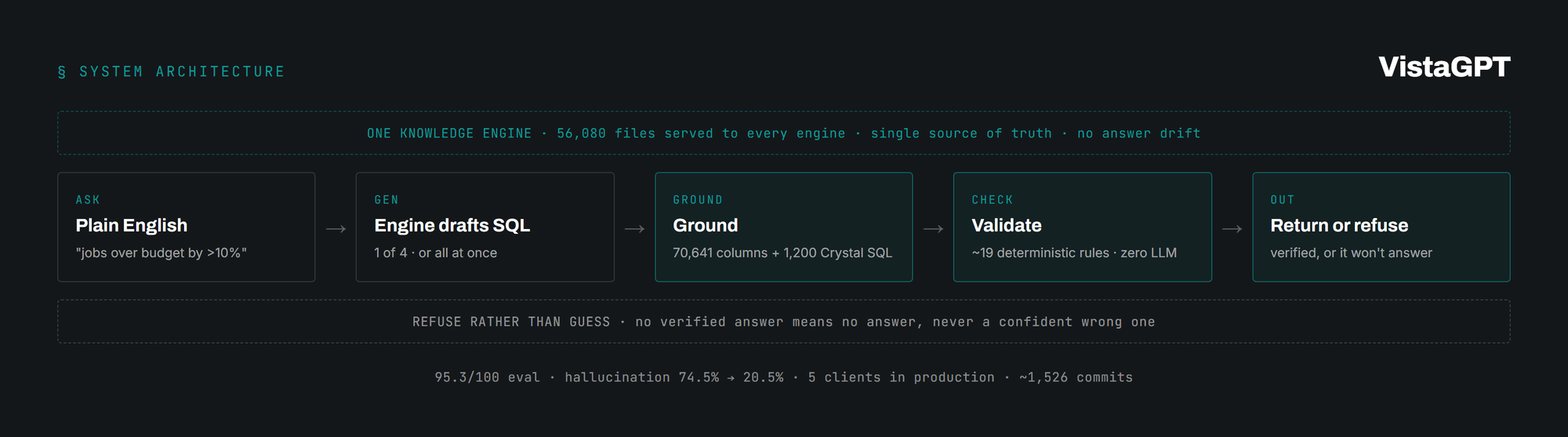
Every query is forced through a deterministic, zero-LLM validation gauntlet before a human sees it. If it can't be verified against the real schema, it isn't returned.

FIG.01, the anti-hallucination validation gauntlet · plain English in, validated T-SQL out (or it refuses)
VistaGPT anti-hallucination gauntlet: a plain-English question is drafted as SQL by one of four engines, grounded against 70,641 columns and 1,200 Crystal Report SQL patterns, validated by ~19 deterministic rules with zero LLM, and returned only when verified, otherwise it refuses rather than guesses. 95.3/100 eval; hallucination cut from 74.5% to 20.5%; one knowledge engine of 56,080 files serves every engine.
§ The bake-off

Watch the engines
compete on your question.

Pick "all at once" and three engines run the same question in parallel, then score 0–100 on accuracy, guardrails and speed. Quality you can watch prove itself, not a claim you take on faith.

FIG.02, engine comparison (illustrative · winner pinned to the audited 95.3/100 SQL eval; other engines are representative deltas, not audited scores)
“Top 10 unpaid vendors this quarter”
CrewGPT✓ winner
95.3
AgentSDK
~91
VistaForge
~84
scored on accuracy · guardrails · speed, winner = audited 95.3/100 eval
§ The ecosystem

Eight services,
one knowledge engine.

VistaGPT is not one model behind a chat box. It is eight production services across two repository generations, three interchangeable SQL engines, a schema-intelligence layer, two augmentation surfaces, and a gateway, all reading one centralized knowledge base. Every cell below is a deployed service in the Codelab era.

ENGINE · 01

CrewGPT V3

The workhorse for multi-table domain reasoning. CrewAI Flow orchestration; a DomainKnowledgeCrew with recall_joins and recall_objects tools that retrieve verified join patterns from the KB instead of inferring them. Mem0 multi-turn memory; guardrails reject any object outside the manifest.

407 commits · 95.3/100 SQL eval
ENGINE · 02

Vista-Engine-AgentSDK

The forensic-accuracy path: a 13-stage hybrid pipeline. Stages 2–7 are six parallel deterministic ChromaDB lookups with zero LLM involvement; Stage 9 Reconcile drops hallucinated schema before the Generator writes SQL. sqlglot validation with up to two auto-retries.

30 commits · 6 zero-LLM stages
ENGINE · 03

VistaForge

A 10-stage quality pipeline grounded in a reference corpus of real production SQL, not synthetic. Stage 4 finds the closest Crystal Report match before generation; a stage0→stage10 smoke-test gate covers every stage. An async stage-10 learning pipeline caches semantically after each query.

29 commits · 1,200+ Crystal Report SQL corpus
SCHEMA · 04

VGPT3

The schema-intelligence layer every engine depends on. A 19,249-entry manifest covering every table, view, procedure and column in Vista. When AgentSDK's Reconcile asks "does this column exist?", it asks VGPT3. 13+ MCP tools; a Gen-2 REST API; no external API keys.

25 commits · <400ms · 743 tests passing
AUGMENT · 05

ExcelMCP

AI inside the Excel teams already use. Five workflows, expert analysis, workbook generation, AI refactoring through 6 hard validation gates, batch processing, and SQL-from-Excel-exports. Dynamic engine selection routes each query to CrewGPT or VGPT3 by query shape.

98 commits · 5 workflows · WF3 = 6 hard gates
AUGMENT · 06

PBI-MCP

A FastAPI MCP server exposing seven Power BI workflows to the pipeline. WF10, the PBIR builder, assembles a full report project, data model, DAX measures, layout, from AI-generated SQL via a --sql flag. A 12-hour manual build collapses to under 5 minutes.

5 commits · WF10 12h → <5min
GATEWAY · 07

UI front / back

A FastAPI gateway routing all eight services through one engine registry, plus a React 18 / TypeScript front end with engine selection. May 2026 added multi-route SSE (parallel streaming from several engines at once), in-chat file uploads, and PBI proxy routes.

56 + 46 commits · engine registry · multi-route SSE
KNOWLEDGE · 08

platform_kb

One centralized platform_kb submodule, synchronized across all eight services. Each service makes HTTP calls to the KB instead of running a local ChromaDB. Add a join pattern once and it is live for CrewGPT's recall_joins, AgentSDK's evidence stages, and VistaForge's corpus at once.

56,080 files · one source · no answer drift
753 commits · GitHub era (Mar–Apr 2026) 773 commits · Codelab era (8 services) ≈ 1,526 commits · two architectural generations
§02, What we built

Two decades of Vista,
encoded and validated.

A generic chatbot would have to re-derive, and get wrong, twenty years of tribal knowledge. This is that knowledge, made into a system.

Four Interchangeable Engines

CrewGPT, AgentSDK, VGPT3 and the next-gen VistaForge sit behind one JSON registry, add or swap an engine with a single edit. The UI runs a live "bake-off": three engines race one question and score 0–100 on accuracy, guardrails and speed.

Anti-Hallucination Validation

Refuse rather than guess. Every generated query is forced through ~19 deterministic, zero-LLM Vista rules, NOLOCK, composite-key joins, fan-out, soft-delete/purge, posting-path NULLs, and verified against all 70,641 real columns before a human ever sees it.

Grounded in Real Reports

Before writing new SQL, the engines reuse 1,200+ proven production Crystal Report queries, so an answer can cite a real, already-trusted report, not an invention.

CrewGPT Multi-Agent

9 agents across 5 crews with a SchemaRetriever grounding over 70,641 columns, a HallucinationGate (5 checks + auto-fix), and self-improving memory that compounds accuracy with use. Hallucination 74.5% → 20.5%; column errors 81 → 2.

Excel "as Code"

51 tools, 5 workflows: extract → analyze → AI-refactor → validate (official Microsoft Power Query parser) → transactional inject with rollback → COM-verify. One client: a 24,997-line manual dump replaced by a single live 57-join query.

One Knowledge Engine

A single Vista knowledge hub, 56,080 files, 809 MB of object docs, schema, reports and traps, serves every engine over one interface. Edit once, propagate everywhere; no answer drift between engines; ~1.5 GB of duplicated copies eliminated.

§ The contract

It refuses,
rather than guesses.

Six structural guarantees stand between a question and an answer. None is a prompt or a hope, each is a deterministic gate or a grounded source of truth that runs before a number reaches a human.

01
Grounded in 19,249 verified schema entries

Every engine reasons over the VGPT3 manifest, every table, view, procedure and column in Vista. An object that is not in the manifest cannot appear in generated SQL, so the system cannot fabricate a table or column name.

VGPT3 · <400ms per lookup · 743 tests passing

02
Zero-LLM deterministic grounding

In the AgentSDK path, Stages 2–7 run six parallel ChromaDB lookups, tables, approach, dates, columns, joins, filters, with no LLM writing anything. The evidence boxes contain only patterns that already exist in the knowledge base.

AgentSDK · 6 parallel evidence stages · no LLM

03
A Reconcile stage that drops hallucinated schema

Stage 9 is a deterministic Python process: it compares every column, join and filter in the proposed blueprint against the platform KB and drops anything not verifiably present, before the Generator LLM writes a single line of SQL.

Stage 9 Reconcile · the second deterministic firewall

04
sqlglot validation with two auto-retries

The final SQL passes through a sqlglot validator with up to two automatic retries for syntactic correctness. A query that cannot be parsed and verified is not what gets streamed back to the user.

sqlglot · ≤2 auto-retries · syntactic gate

05
One knowledge engine, no answer drift

All eight services read a single centralized platform_kb over HTTP rather than per-service ChromaDB copies. Edit a join recipe once and every engine sees it. There is no version of the schema that one engine trusts and another does not.

platform_kb · 56,080 files · single source of truth

06
Grounded in real reports, then regression-tested

Before inventing SQL, VistaForge reuses 1,200+ production Crystal Report queries so an answer can cite a report that is already trusted. The pipeline's stage0→stage10 smoke tests and VGPT3's 743 tests keep that grounding honest as the system changes.

1,200+ Crystal Report corpus · stage0→stage10 gate

§03, Results

What changed,
measured.

Measured on real Vista data, the delta between the DBA-gated status quo and the shipped platform.

Power BI PBIR builds: 12 hrs under 5 min

a Power BI PBIR report that took ~12 hours by hand is generated from a prompt on real Vista data in under 5 minutes

Wrong answers, engineered out
Schema hallucination74.5% → 20.5%
−72% cut
Column errors per benchmark81 → 2
−98% cut
Who can query the ERP DBA-onlyanyone in finance
Time to a report days, via a ticketseconds, self-serve
Excel refresh speed brittle, manual~80% faster
A wrong-but-confident report silent, 5–30% offrefused, never shown
§04, Engineering depth

Not a prototype.
A two-year-of-work program.

A platform that refuses to guess earns that posture in commits, tests and live clients, not in slideware. Here is the audited record behind the claim.

Commit history · two generations
753GitHub era 773Codelab era · 8 services
≈ 1,526 total commits, Mar 2026 → present

The Codelab era alone covers a V3 CrewGPT rewrite (407 commits), a 13-stage AgentSDK pipeline built from scratch, VistaForge's 10-stage quality pipeline, a full front-end and back-end rebuild, and a new Power BI MCP service, inside a two-month window.

Observability · live across the stack

On May 22, 2026, LiteLLM proxy and Langfuse tracing were merged across all eight services at once. Every LLM call in every pipeline stage is now traced end-to-end, token spend, per-stage latency and model routing are observable at the platform level, not per service.

In production · five Vista clients
  • Chamberlinfinancial reporting
  • Delnorproject cost tracking
  • EmerySappmulti-module ERP queries
  • JC ConstructionExcel workbook analysis
  • JCWIPjob-in-progress analysis
Production deployments, not pilots, all eight services confirmed live in the Codelab era.
95.3/100CrewGPT static SQL benchmark, the audited eval
74.5% → 20.5%schema hallucination across iterative development, a 72% reduction
12h → <5minWF10 PBIR build, a full Power BI report project, no manual steps
§ Stack

Vertical depth,
Microsoft-first.

Validation leans on Microsoft's own parsers and schemas as the authority, making "wrong-but-plausible" output structurally hard to ship.

CrewAIAnthropic ClaudeFastAPIMem0QdrantChromaDBsqlglotOffice COMpbi-tools.coreMicrosoft FabricReact 18Langfuse
Start a project

Run on a gnarly ERP,
or get paid to tame it?

Whether your team waits days for reports or you're a consultancy that builds them for a living, we'll build a trustworthy conversational layer over the database, grounded, validated, and engineered to refuse rather than guess.

AGENTIX TECH · case file 03 · VistaGPT · it refuses rather than guesses